Tapada Nacional de Mafra
Tapada Nacional de Mafra
A former 18th-century royal hunting estate classified as UNESCO heritage, Tapada Nacional de Mafra blends royal legacy, wildlife and marked trails 40 km from Lisbon.
Once a royal hunting ground established in the 18th century, Tapada Nacional de Mafra is today a walled natural park spanning approximately 819 hectares, roughly fifty kilometres northwest of Lisbon. Inscribed with UNESCO in 2019 alongside Mafra's palace and convent, it can be explored on foot, by bicycle or through guided tours, amid diverse wildlife.
Why visit Tapada Nacional de Mafra
Tapada brings together three interests rarely combined on a single Portuguese site: royal heritage linked to Mafra's monumental ensemble, freely observable wildlife within a half-day (deer, fallow deer, wild boar, raptors) and several marked trails of varying difficulty. The park remains spacious enough to accommodate visitors without overcrowding, and proximity to the Ericeira coast allows combining forest and seaside within a single day.
Heritage enthusiasts discover a testament to the Portugal of John V; hikers and mountain bikers find a secure, enclosed domain; families enjoy engaging visits thanks to the geolocalised audioguide activated by QR code.
A royal reserve that became UNESCO heritage
Tapada Nacional was established in 1747 under the reign of King John V (1706-1750), nicknamed the "magnanimous king". An enthusiast of hunting, the sovereign desired a private recreational estate in close proximity to his Mafra palace, whose construction began in 1717 and extended over some thirty years. Beyond hunting, Tapada's woodlands supplied heating and essential products to the adjoining convent.
On July 7, 2019, UNESCO inscribed the Mafra royal ensemble as world heritage: the palace, the basilica and its two 68-metre towers of baroque inspiration, the convent of the Franciscan order, the Cerco garden and Tapada itself form a coherent whole, testament to Portuguese monarchical taste of the 18th century.
What you observe in the park
Wildlife
The gently rolling relief and mosaic of habitats shelter dense wildlife, partly observable from the trails:
- Cervids: red deer, roe deer and fallow deer, recognisable by their palmate antlers
- Raptors: Bonelli's eagle, kestrel, eagle owl and short-toed snake eagle, specialising in reptile hunting
- Discreet mammals: wild boar, mongoose and genet, a small spotted carnivore of the viverrid family
Forests and flora
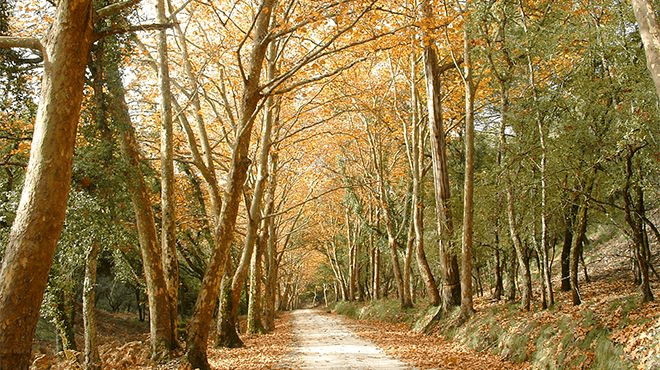
Vegetation alternates between pine forests, cork oak woodlands, eucalyptus, chestnut trees and Judas tree (Cercis siliquastrum), a deciduous tree whose pink flowering marks springtime. The cork oak, emblematic of Portugal, is distinguished by its thick bark traditionally harvested for cork.
Hiking and mountain biking trails
The park offers four colour-coded walking circuits:
- Blue route: 4.8 km
- Red route: 6.3 km
- Green route: 8 km
- Yellow route: 8.7 km
Three mountain biking circuits of 8 to 15 km supplement the offer. Allow a half-day for a short walking route, a full day to combine hiking and wildlife observation.
Practical information
Entry is at the main ticket office, where you collect your access ticket. It bears a QR code providing access, via smartphone, to a detailed map, a fifteen-themed commented itinerary and a geolocalised audioguide indicating your position in real-time within the park, without requiring a dedicated application.
Entry fees remain modest and vary according to the chosen format (free visit on foot, by bicycle or guided circuit by vehicle). The park is open year-round, with extended hours in summer season; it is advisable to check the day's hours before departing. Bring closed shoes, water and binoculars for wildlife observation.
When to visit
Mafra enjoys a temperate Mediterranean climate moderated by Atlantic proximity, with annual rainfall around 677 mm concentrated in winter. The most pleasant period spans May to October, with average temperatures around 23 °C. Spring offers the best conditions for flora and raptor observation; autumn, quieter, favours listening to the deer rut. Summer remains practicable, but favour early morning departures to avoid heat and more easily encounter wildlife.
How to get there
Mafra lies approximately 40 km northwest of Lisbon. By car, the N9-2 route crosses the Tapada sector and directly serves the main entrance; allow 45 minutes to one hour from Lisbon depending on traffic. By public transport, several bus lines connect Lisbon (Campo Grande bus station) to Mafra; there is no rail link or metro from the capital. From Mafra town centre, Tapada is reached by taxi or car within minutes.
Nearby attractions
A visit to Tapada naturally extends to other components of Mafra's UNESCO site: the royal palace, basilica and convent (convent visits by appointment). In Sobreiro, a few kilometres away, José Franco's reconstructed village, classified as an ethnographic museum, restores the region's crafts and rural traditions. The seaside resort of Ericeira, renowned for surfing, lies 8 km away and makes for a pleasant evening stop.
To continue exploring Portugal's coastal and cultural heritage, you can combine this visit with other sites such as Costa Nova and its striped houses, or the Burel Factory in Serra da Estrela.
Frequently asked questions
Frequently asked questions
Allow 2 to 3 hours for a short walking route or a guided vehicle tour, and a half-day to a full day for longer trails or a mountain biking outing.
Yes, independent visits are possible on foot or by bicycle along marked trails. Guided vehicle circuits are also available and provide access to more remote areas.
Deer, fallow deer and wild boar are regularly observed, especially early morning and late afternoon. Raptors can be spotted above clearings. Binoculars are helpful.
Yes. The blue route (4.8 km) remains accessible and the themed QR code audioguide makes the visit engaging. Guided vehicle circuits suit younger visitors.
Both sites lie a few kilometres apart. You can spend the morning at Tapada and the afternoon at the palace, basilica and convent, all classified as UNESCO heritage since 2019.
Extend your experience in Portugal
Tapada Nacional naturally integrates into an itinerary combining royal heritage, Atlantic nature and traditional villages. To craft a bespoke journey including Mafra, Ericeira and other stops, consult our Portugal travel suggestions.

Interested in this visit?
We can include it in your personalised itinerary.