How to visit Lisbon aboard the legendary Tram No. 28?
Although it began as a simple means of public transport, Tram No. 28 is, in itself, one of the city's main tourist attractions. Where to catch Tram 28?
Although it began as a simple means of public transport, Tram No. 28 is, in itself, one of the city's main tourist attractions. Where to catch Tram 28 ? What is its route ? Where should you stop to see the must-see sites ? How much does it cost ? Discover our comprehensive guide to visit Lisbon aboard the legendary Tram No. 28.
A brief history of Lisbon's tramways
Lisbon's first electric tramways came into being in 1901. These historic tramways were introduced to replace horse-drawn carriages, which had been the city's main means of transportation until then.
Despite the development of other transport modes (buses, subway...), the electric tramways, recognizable by their bright yellow color, have always been preserved. Although they have retained their period-era equipment (dials, levers, leather and wooden seats...), they were nevertheless renovated in the 1990s (hence their name "Remodelados" tramways, meaning remodeled), particularly to improve the braking system.
If they remain in circulation today and have not been replaced by more modern models, it is because they were designed to navigate the winding streets of Lisbon's historic center, such as those in the Alfama district.
Today, the city boasts 31 kilometers of network with 6 lines of historic tramways in excellent condition. All historic tramways are part of Carris, Portugal's public transport company. Among the 6 lines in the historic network, the most famous is line No. 28. It was inaugurated in 1914 and has been voted several times as "the world's best tram route".
Good to know: If Lisbon's tramway history interests you, visit the Carris Museum (Museu da Carris). Located in the civil parish of Alcântara in Lisbon, this museum traces the history of the city's public transport and allows you to board several historic vehicles.
Where does Tram No. 28 go ?
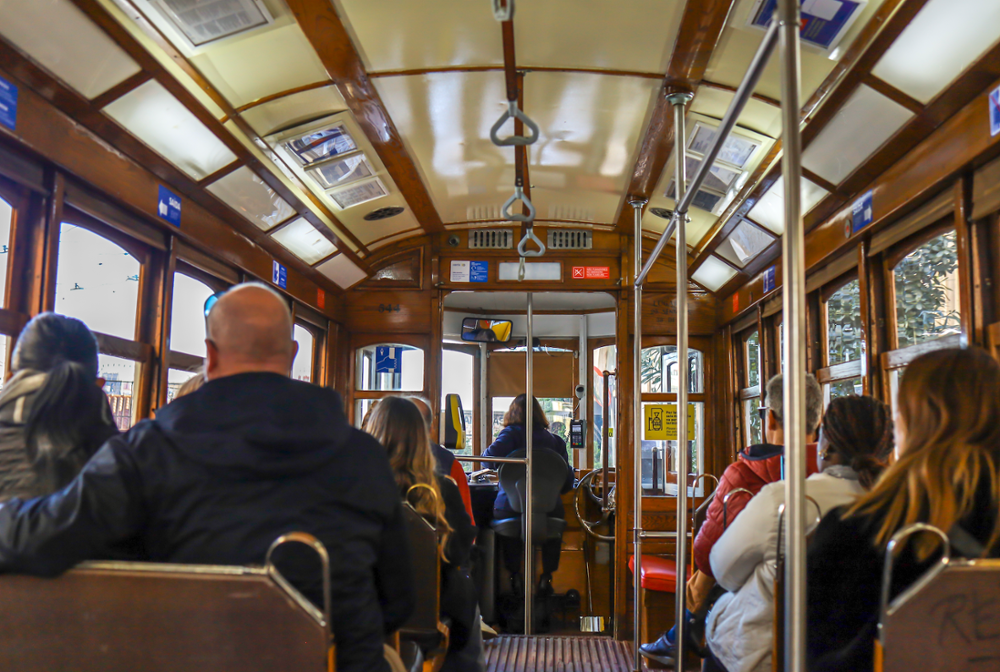
The route covered by Tram No. 28 is 7 km long and serves two terminals (depending on the direction of travel): Martim Moniz and Campo de Ourique.
Here is the complete list of Tram No. 28 stations:
Martim Moniz
R. Palma
Anjos Church
R. Maria Andrade
R. Maria Fonte
R. Angelina Vidal
Sapadores
R. Graça
Graça
Voz Operario
Cç. S. Vicente
R. Escolas Gerais
Lg. Portas Sol
Miradouro Sta. Luzia
Limoeiro
Sé
R. Conceição
Lg. Académie nationale des beaux-arts
R. Vitor Cordon / R. Serpa Pinto
Chiado
Pç. Luis Camões (B.Alto)
Calhariz (Bica)
Sta. Catarine
Cç. Combro
R. Poiais S. Bento
RS Bento / Cç. Étoile
Cç. Estrela / R. Borges Carneiro
Cç. Estrela / R. Dr. Teófilo Braga
Estrela (Basilica)
Estrela - R. Domingos Sequeira
R. Domingos Sequeira
R. Saraiva Carvalho
Sto. Condestável Church (C. Ourique)
Campo Ourique (Prazères)
Note: The journey from Martin Moniz to Campo Ourique takes 40 minutes in total.
What are the must-see stops on Tram No. 28 ?
In addition to offering a unique experience, Tram No. 28 passes through several must-see neighborhoods in the city including Graça, Alfama, Baixa, Chiado and São Bento. Here are the main tourist sites you can see along the route:
Must-see stops in the Graça district
Located on the highest of the city's 7 hills, Graça is a lofty neighborhood where you can enjoy some of the most beautiful views over Lisbon.
R. Graça stop: Getting off here, you can reach two must-see miradouros (viewpoints) in Lisbon: Miradouro Nossa Senhora (which is the city's highest vantage point) and Miradouro da Graça (also called Sophia de Mello Breyner Andresen). The second is located next to the Graça church and monastery, sites you shouldn't miss either.
Cç. S. Vicente stop: This stop allows you to reach the Igreja São Vicente de Fora (St. Vincent Monastery). You will see a beautiful collection of azulejos (tiles) and can access a terrace with views over Lisbon.
Must-see stops in the Alfama district
The oldest district in Lisbon, Alfama is THE emblematic neighborhood of the city. Although it deserves to be discovered in its entirety, here are the stops you shouldn't miss if you're traveling aboard Tram No. 28:
Lg. Portas Sol stop: From here you can reach the Miradouro das Portas do Sol, another exceptional viewpoint over the Graça district, the rooftops of Alfama and the Tagus River. You can also reach the Museu de Artes Decorativas (Museum of Portuguese Decorative Arts).
Miradouro Sta. Luzia stop: The next stop also provides access to one of Lisbon's miradouros, that of Santa Luzia. This is also where you can reach the must-see Castelo de São Jorge (St. George's Castle).
Sé stop: Getting off at this stop, you can see Lisbon's cathedral called the Catedral de Santa Maria Maior or the Sé. With a history of over 800 years, it is Lisbon's oldest church. A few meters away, you will also find the Igreja de Santo António (St. Anthony's Church).
Must-see stops in the Baixa district
Although line 28 passes quickly through the Baixa district, we recommend you stop there. Indeed, Baixa is the city center and houses some of the city's most iconic monuments.
R. Conceição stop: Stop here to visit the Baixa district, the shopping street Rua Augusta and its famous triumphal arch (Arco da Rua Augusta) as well as Praça do Comércio (Commerce Square) considered to be Lisbon's most beautiful square. Note that MUDE (Museu do Design e da Moda, Design and Fashion Museum) is located just around the corner.
Must-see stops in the Chiado district:
Located between the Baixa district and Bairro Alto, the Chiado district stands out for its beautiful 17th-century buildings and cultural sites. It is often considered the neighborhood of intellectuals and literary figures.
Chiado stop: Near this stop, you can discover the famous Elevator de Santa Justa. We also recommend you visit the Convento do Carmo (Carmo Convent) to see the ruins of the capital's former Gothic church which was destroyed during the 1755 earthquake. You will also find the Carmo archaeological museum here.
Must-see stops in the Bairro Alto district:

Bairro Alto is the most lively and festive neighborhood in the city. In addition to its many bars and nightclubs, you will also find designer boutiques, concept stores and trendy cafes.
Pç. Luis Camões (B.Alto) stop: Get off here to explore the neighborhood and its alternative venues.
Calhariz (Bica) stop: From this stop, you can reach the Ascensor da Bica. Inaugurated in 1892, it is one of the city's three historic funiculars.
Sta. Catarine stop: Here you will find another must-see viewpoint: the Miradouro Santa Catarina with its enchanting view over the Tagus, the April 25th Bridge and Christ the King in the background.
Must-see stops in the São Bento district
The São Bento district is particularly known for its Palácio de São Bento and the Casa-Museu Amália Rodrigues.
Cç. Estrela / R. Borges Carneiro stop and Cç. Estrela / R. Dr. Teófilo Braga stop: These two stops allow you to reach the Palácio de São Bento (Palace of the National Assembly of Lisbon) as well as the Fundação Amália Rodrigues (Amália Rodrigues Foundation) which is the home-museum of the famous Fado singer.
Must-see stops in the Estrela district
The tour soon comes to an end in the Estrela district, a quiet and verdant neighborhood where visitors like to go to escape the crowds of the city center.
Estrela (Basilica) stop: Here you can visit the Basílica da Estrela (Estrela Basilica), a Portuguese baroque-style basilica. The first church in the world to be consecrated to the Sacred Heart, it is one of Lisbon's most important religious buildings. In front of the basilica, don't overlook the Jardim da Estrela (later renamed Jardim Guerra Junqueiro), an English-style garden with romantic inspiration where it's lovely to stroll.
What are the schedules for Tram No. 28 ?
The first tram departs every day around 5:40/45 from Martim Moniz (at 6:45 on Sundays and public holidays) and the last tram departs at 11:30 PM. Departing from Campo Ourique, the first tram leaves at 6:20 AM and the last departs at 11:52 PM.
Please note that schedules are subject to change. Find the exact schedules for the No. 28 tram line on the Carris website.
How much does a ticket for Tram No. 28 cost ?
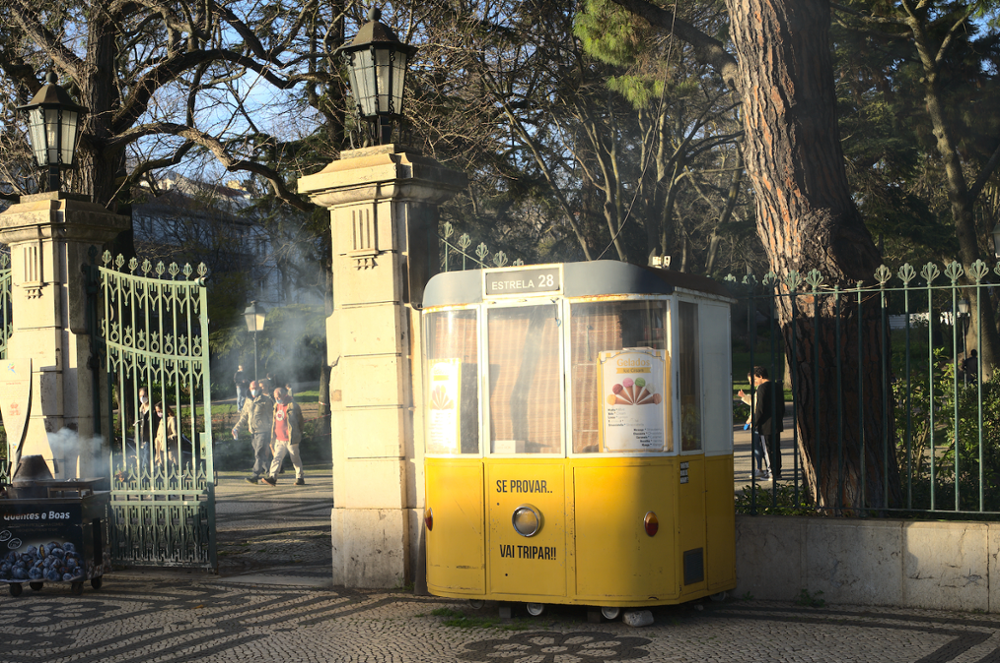
Like all other tramways, the price of a ticket to travel on line No. 28 is 3 euros per trip. The ticket can be purchased directly when boarding the tram.
Would you like to make multiple stops by getting back on the tram after each visit without having to pay a ticket each time? To be able to get off en route and catch Tram No. 28 several times, you have two options:
24-hour ticket: At 6.60 euros, this travel pass allows unlimited travel for 24 hours on the entire Carris network (including Tram No. 28). More information on www.carris.pt
The Lisboa Card: This card allows you to travel free and unlimited throughout Lisbon using the subway, buses, tramways (including Tram 28) and funiculars. It also provides access to 38 museums and monuments in the city, the Santa Justa elevator, the Torre de Belém and the Mosteiro dos Jerónimos... Its price starts from 22 euros for 24 hours and increases depending on the number of days you wish to use it. More information on www.lisboa-card.com.
Frequently asked questions
A single ticket for Tram No. 28 costs 3 euros. It can be purchased directly on board the tram. If you want to make multiple stops, opt for the 24-hour ticket at 6.60 euros (unlimited Carris network) or the Lisboa Card starting at 22 euros for 24 hours, which also includes access to 38 museums and monuments.
The first Tram 28 departs from Martim Moniz around 5:40-5:45 AM (6:45 AM on Sundays and public holidays). The last departure is at 11:30 PM. From Campo Ourique, the first tram departs at 6:20 AM and the last at 11:52 PM. Schedules are subject to change: check the official Carris website for exact times.
The complete journey on Tram No. 28, from Martim Moniz to Campo Ourique, takes approximately 40 minutes. The total route covers 7 km and serves about thirty stops while crossing the districts of Graça, Alfama, Baixa, Chiado, Bairro Alto, São Bento and Estrela.
Yes, the Lisboa Card is accepted on Tram No. 28. It allows you to travel free and unlimited on Lisbon's public transport network (subway, buses, tramways, funiculars). Its price starts from 22 euros for 24 hours. It also includes access to 38 museums and monuments.
Tram 28 is very popular and can be crowded during peak hours and high tourist season. For more comfort, it is advisable to take the tram early in the morning (before 9 AM) or in the late afternoon. Boarding from the Martim Moniz terminus usually guarantees you a seat. Also keep an eye on your belongings, as pickpockets are active on this heavily traveled line.
Most travelers recommend taking Tram 28 from Martim Moniz toward Campo Ourique. This direction allows you to gradually climb Lisbon's hills and enjoy the scenery. You will first discover the Graça district, then Alfama, before reaching the city center (Baixa, Chiado) and the quieter neighborhoods of São Bento and Estrela.