Alentejo
One-third of Portugal for just 7% of the population: cork oak plains, Roman Évora, Alqueva's starry nights and the wind-swept Vicentina coast.
Alentejo occupies roughly one-third of Portugal's territory between the Tagus to the north and the Serra do Caldeirão to the south, yet holds barely 7% of the population. This sparse settlement explains the landscape we encounter leaving Lisbon via the A2: rolling grain fields, cork oaks and holm oaks planted in montados (the agro-sylvo-pastoral savanna distinctive to the Iberian Peninsula), herds of black Alentejo pigs feeding on acorns in autumn. This is the raw material for Barrancos ham and the cured meats that accompany our lunches in countryside taverns.
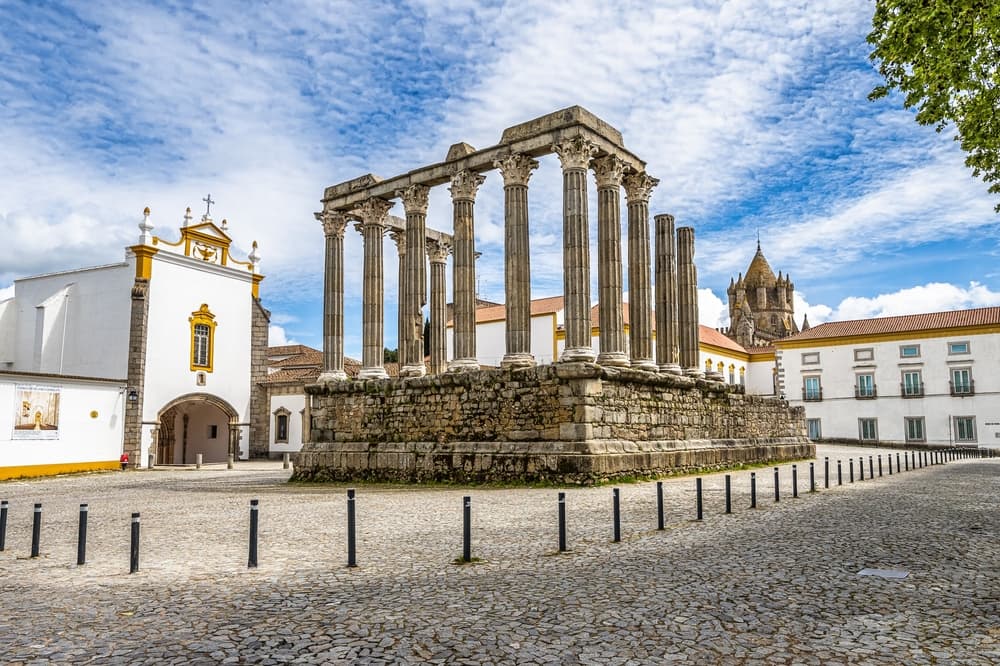
Évora, a 90-minute drive from the capital, serves as the gateway. The city preserves within its walled centre a Roman temple from the 1st century dedicated to imperial worship, a 13th-century Gothic cathedral, and the Capela dos Ossos in the São Francisco church, whose walls are lined with the remains of some 5,000 deceased. Around Évora, Alentejo's megalithic heritage encompasses over 150 recorded sites: the Almendres cromlech, dated to around 6000 BCE, aligns 95 granite menhirs across a hillside planted with cork oaks.
To the east, the Alqueva dam on the Guadiana river has formed since 2002 Western Europe's largest artificial lake (250 km²). The fortified village of Monsaraz, perched at 342 metres on a schist ridge, overlooks it. The area has been designated a Dark Sky Reserve by the Starlight Foundation since 2011, making it one of the continent's most accessible stargazing sites: we organise telescope evenings on the lake shore, ideal between May and October.
The north-east, towards the Spanish border, shifts in character. The Serra de São Mamede peaks at 1,025 metres and concentrates humidity the rest of the region lacks: chestnut groves, year-round streams, a microclimate 4 to 6 degrees cooler. Marvão, clinging at 865 metres to a quartzite spur, and Castelo de Vide, renowned for its 14th-century Jewish quarter and thermal springs, are our two bases for this part of the territory. The road between Portalegre and Castelo de Vide winds through ancient olive groves and terraced vegetable gardens that echo the nearby frontier.
The Alentejo coast, called Costa Vicentina in its southern stretch, runs for 100 kilometres from Porto Covo to Odeceixe. Schist and sandstone cliffs, cove beaches, persistent north-westerly winds in summer: Zambujeira do Mar, Almograve, Vila Nova de Milfontes at the mouth of the Mira. The Sudoeste Alentejano Natural Park protects the entire coastline, explaining the absence of large beach resorts unlike neighbouring Algarve. The Rota Vicentina, a marked long-distance trail established in 2013, hugs the cliffs for roughly 230 kilometres and allows multi-day hiking stage by stage, with village accommodation.
On the table, Alentejo asserts itself through hearty dishes born of pastoral economy: garlic and coriander açorda, sopped bread migas, ensopado de borrego (braised lamb), pan-fried black pork. Alentejo DOC wines, built around Aragonez, Trincadeira and Alicante Bouschet grapes, have risen to prominence since the 1990s; quintas around Reguengos, Borba and Vidigueira welcome visitors for tastings.
Must-see highlights
Almendres cromlech and Évora's megaliths. 95 granite menhirs raised around 6000 BCE on a hillside dotted with cork oaks, 15 km west of Évora. Access by track, free entry, oblique late-afternoon light is ideal.
Alqueva's night sky. Constellation viewing on the shore of Western Europe's largest artificial lake, under a certified Dark Sky Reserve. Evenings with a local astronomer from May to October, from Monsaraz or Cumeada.
Marvão and the Serra de São Mamede. Fortified village at 865 metres on a quartzite spur, dominating the Spanish plains. 4 to 6 degrees cooler than the lowlands in summer, with chestnut groves and springs around Castelo de Vide.
Rota Vicentina on the wild coast. Cliff-top trail between Porto Covo and Odeceixe, stages of 15 to 22 km, village lodgings. Blooms April to May, storks nesting on bare rock at Cape Sardão.
Tables and cellars of Alentejo DOC. Quintas around Reguengos, Borba and Vidigueira for structured reds; lunch of açorda and black Alentejo pork in a village tavern after tasting.
When to visit
The most comfortable window stretches from mid-April through mid-June, then mid-September through late October. Daytime temperatures hover between 20 and 28 degrees, evenings stay cool indoors (12 to 15 degrees), and landscapes are green in spring, golden in autumn. July and August regularly exceed 38 degrees in the plains, with peaks of 42 or 43 degrees in Évora and Beja; we advise against these months for heat-sensitive travellers unless your stay concentrates on the coast, where north winds drop temperatures by 8 to 10 degrees.
Winter, December through February, remains mild by day (12 to 16 degrees) but damp and windy, with roughly 80 mm of rain monthly on average and nights dropping to 3 or 4 degrees inland. This is game season at table, almond blossoms flowering by late January in the north-east, and mushroom-hunting season in the Serra de São Mamede. The Vicentina coast empties almost entirely then, which appeals to some walkers.
Practical advice
We recommend a minimum of 4 full days to grasp interior Alentejo (Évora, megaliths, Monsaraz, a quinta), and 6 to 7 days if you add the Vicentina coast or the Serra de São Mamede to the north-east. Distances look modest on the map but secondary roads move slowly: allow 2.5 hours from Évora to Marvão, 2 hours from Évora to Vila Nova de Milfontes. A rental car is essential; Lisbon airport is the entry point (1.5 hours' drive to Évora).
Alentejo pairs naturally with Lisbon and Sintra upstream, and with Algarve downstream (1.75 hours from Zambujeira to Lagos). A longer loop can include the Centre and Serra da Estrela to the north. The region suits contemplatives, pre-Roman and Roman heritage lovers, wine enthusiasts, coastal hikers and families seeking an unhurried pace. Lodging centres on restored monte farmhouses and a few pousadas set in convents or castles; comfort is high but isolation is real—plan dinners ahead outside peak season.