Linhares da Beira
Linhares da Beira
At the gates of Serra da Estrela, Linhares da Beira reveals its Gothic castle, Roman streets, and intact medieval heritage, designated as an Aldeia Histórica.
Linhares da Beira is a medieval open-air museum crowned atop the northwestern slope of Serra da Estrela. Renowned for its architectural richness, this hamlet bears witness to the glory of ancient Portuguese royalty. Its imposing castle, streets, and fortifications transport you deep into history, to the reign of D. Afonso Henriques or King Dinis.
History
Beira was long occupied by Romans, then Visigoths and Arabs, before being reconquered by the Portuguese under D. Afonso Henriques (Portugal's first king). He founded the village of Linhares da Beira in 1169. Linhares retained this status until the liberal administrative reform of 1855, when the charter granted by D. Afonso Henriques was abolished. Later, Linhares was integrated into the defensive system that served as a bulwark for the Mondego basin. Until the 17th century, the village played a military role, guarding the borders of Beira.
The successive kings each left their mark on the history of Linhares da Beira during their respective reigns.
- Sancho I (1185-1211) built the fortress of Linhares
- Mayor Rodrigo Mendes erected a chapel here in honor of his victory over Castilian invaders
- Dinis (1261-1325) commissioned a vast castle, one of the region's most captivating Gothic fortresses, standing to this day.
Why Visit Linhares da Beira?
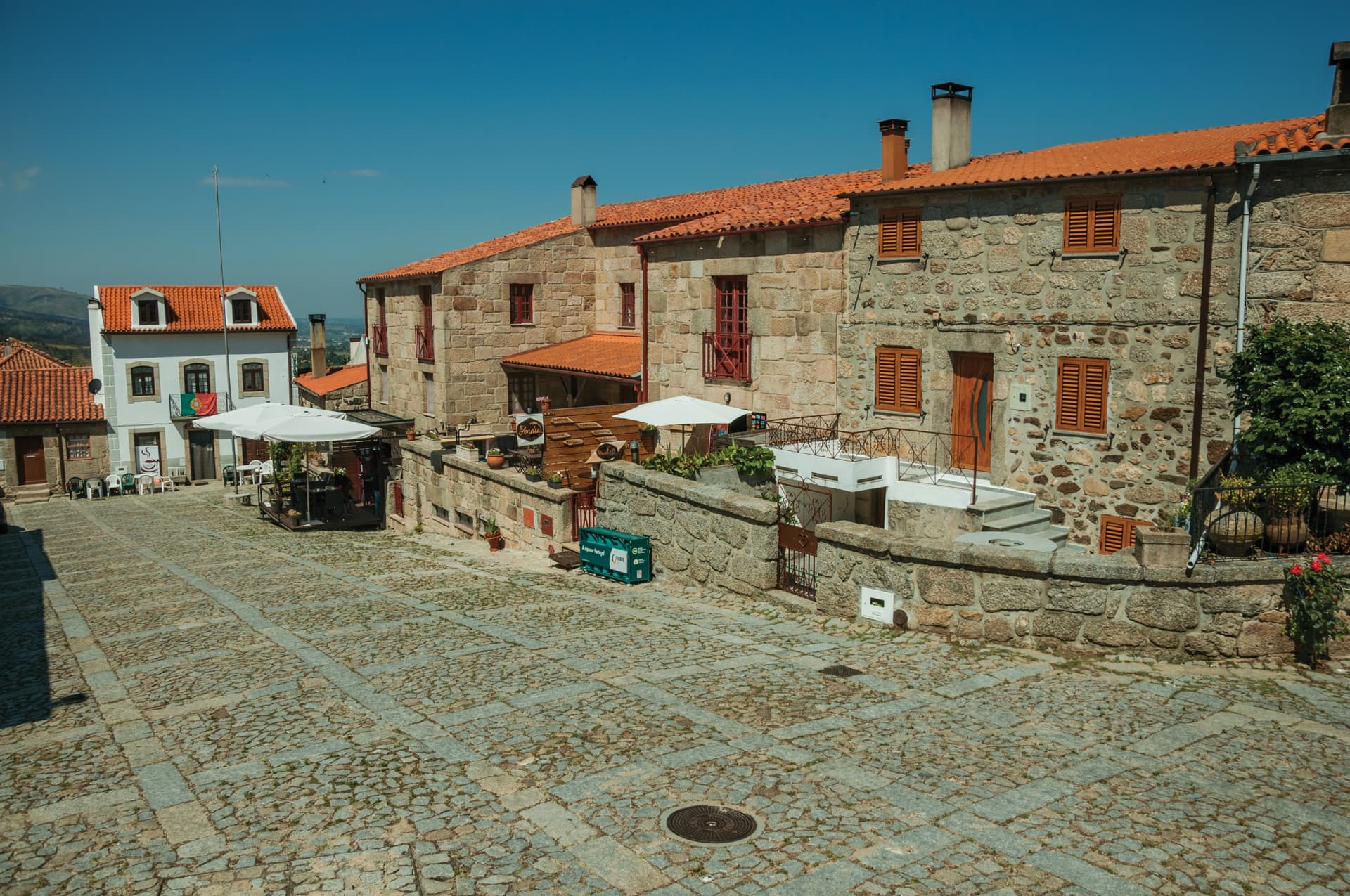
The charm of Linhares da Beira lies in its medieval setting. With winding streets, stone houses guarded by gargoyles, Manueline doorways, and baroque solarium windows, Linhares da Beira has become an open-air museum within the Serra da Estrela national park.
The Former Town Hall
This building from the era of Queen Maria (1777-1816) stands at the heart of a small cluster of municipal buildings including the forum and pillory. The grille on the left window of its ground floor indicates the building once served as a prison. Inside, three rooms occupy the upper floor, including a reception hall. These spaces once served as schoolrooms and teachers' quarters. Today, the arms from the Queen's time and several historical installations from the town hall are on display.
The Old Inn
This inn's structure is typical of medieval times. You'll notice two gargoyles at the building's extremities. According to local legend, the inn's former proprietress, Dame Lopa, made a pact with the devil. The gargoyles adorning the edifice are said to represent the devil and a goat. Bound by this diabolical force, Dame Lopa sought help from Saint Anthony. He freed her from evil. In gratitude to God, Dame Lopa erected a statue of His holy servant.
Beyond the mysteries surrounding this inn, the building is equally renowned for its significant medieval role. Following King Sancho I's death, the "Brotherhood of Mercy" established itself in Linhares da Beira, fulfilling the late monarch's final wishes. The brotherhood converted the inn into the "Hospital of Mercy." The inn-hospital offered aid and shelter to the poor, the sick, and pilgrims passing through the Beira region.
The Almocrevs' Route
Linhares da Beira is crossed by the Via da Estrela (Way of the Star), a cobbled pathway of granite blocks dating to Roman occupation that connects Mérida to Braga. The stretch passing through Linhares forms part of the hiking circuits within Serra da Estrela national park. This "Roman road" runs through the village to the Linhares river, spanning 1,300 meters.
The Castle
The castle of Linhares has stood at 800 meters altitude on rocky terrain since its construction by King Sancho I. His Majesty D. Denis had the castle renovated in 1291, transforming it into the defensive fortress protecting Beira's eastern borders. In 1922, UNESCO designated the castle of Linhares as a historical monument.
The fortress boasts two immense towers: the clock tower and the keep. Behind its walls lie two large spaces. The western space served military purposes and housed water cisterns. The eastern space provided refuge for villagers during enemy attacks. The castle of Linhares functioned as both a barracks and medieval bunker.
Spring Well and Forum
Members of Linhares's assembly of free men regularly convened at this emblematic site to make administrative, legislative, and judicial decisions. In Portugal, such gathering places are called "forums." Linhares's forum is distinguished by its elegance: a table surrounded by benches bearing Linhares's coat of arms on their backs. The entire structure, constructed of granite with wooden framework and tile roof, creates an inviting gathering space.
Best Time to Visit?
June through September offers the most favorable conditions for visiting Linhares da Beira. Days are sunny with moderate rainfall averaging 14 mm. Daytime temperatures rarely exceed 25°C, dropping to around 14°C at night.
Linhares da Beira is accessible by car. If using public transportation, buses service the Carrapichana stop. From there, you'll need a taxi to reach the village.
Linhares da Beira features a network of pedestrian streets, some dating to the Roman occupation era. Exploring the village is best done on foot or by bicycle.
Want to discover this destination?
Our local advisors design your tailor-made trip.