Nazaré
Nazaré
Towering waves, dramatic cliffs, and a traditional fishing village: Nazaré, an Atlantic gem nestled between Lisbon and Porto, blends extreme surf culture with spiritual heritage.
Nazaré is a coastal Portuguese town situated in the Leiria district, in western Portugal. It is primarily renowned for its mythical waves, which rank among the highest in the world. Yet this compelling destination holds far more to discover. You will find yourself captivated by its distinctive culture, exceptional gastronomy, religious and historical monuments, the beauty of its beaches, and the panoramic vistas it offers at every turn.
Legend and History
The name Nazaré is believed to derive from a small statue of the Virgin Mary, brought by a monk from Nazareth in Spain during the 4th century. The statue was later introduced to Portugal by another monk called Romano, accompanied by Roderic, the last Visigothic king of what is now Portugal. Both became anchorites (religious hermits living in solitary retreat). Romano isolated himself in a cave perched on a cliff. Following his death, the king buried him in his refuge and left the small sculpture behind.
In 1182, the knight Dom Fuas Roupinho was pursuing a deer near the cliff edge, riding his horse at full gallop through thick fog. Realizing the horse was leading him toward a sheer drop, he cried out loudly to the Virgin Mary for help, and the animal stopped abruptly. In gratitude for this miraculous intervention, he commissioned the construction of a chapel. In 1377, as the number of pilgrims grew, King Fernando I of Portugal had a church built (Santuário de Nossa Senhora da Nazaré) near this chapel and transferred the statue there.
Nazaré is divided into three neighborhoods: Praia, which runs along the main beach; Sítio, nestled atop a cliff; and Pederneira, situated on a hillside. For centuries, residents inhabited these two elevated parts of town to protect themselves from Viking raids, followed by attacks from French, English, and Dutch pirates. It was only in the 19th century, as piracy began to decline, that they settled in what is now the Praia neighborhood.
What to See in Nazaré?
The Beaches
Praia da Nazaré
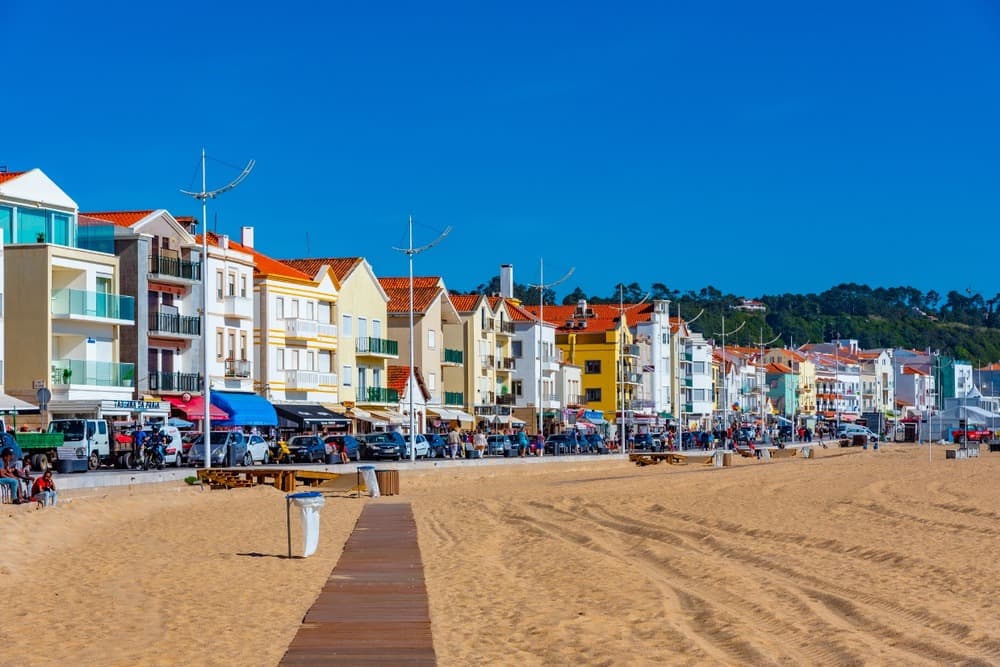
This is the town's main beach and also ranks among the country's finest. With its golden sand, gentle breezes, and mild current, it is the preferred spot for visitors to relax and swim. Traditional fishing boats are displayed at the center of this expansive beach, a reminder of the town's deep maritime heritage. You will also encounter women wearing traditional skirts, selling dried fish laid out on racks.
Praia do Norte
Located north of Nazaré, this beach is home to colossal waves reaching up to 30 meters in height. It gained international fame when American surfer Garrett McNamara set the world record for the largest wave ever surfed in 2011. This phenomenon is created by a vast submarine canyon located offshore and extending 5 kilometers in depth.
Historical Heritage
Santuário de Nossa Senhora da Nazaré
This is the religious temple erected by King Fernando I to house the Virgin Mary statue. The sanctuary underwent major transformation in the 16th century. Its interior, adorned with a gilt retable and walls decorated with Dutch tile panels, dates from this period. In the right wing of this church, you will find an exhibition of objects, statues, and liturgical vestments, most of which were donated by the faithful.
Ermida da Memória
This is the small chapel built to give thanks to the Virgin Mary. The interior is covered in magnificent Baroque tiles.
Forte de São Miguel Arcanjo
Constructed in the 16th century on a rocky promontory, this fort played a crucial role in protecting Nazaré from pirate attacks. It commands a privileged vantage point for observing the colossal waves of Praia do Norte. Within this fortress sits a small museum displaying surfboards from notable athletes. A lighthouse crowns its roof.
Viewpoints
Miradouro de Pederneira
Located in the Pederneira neighborhood within a wooded area, it offers a magnificent panorama across much of the town. From here you can admire the Peniche coastline, the pine forests of Leiria, Sítio, the marina, and the vast Atlantic Ocean.
Miradouro de Suberco
Situated atop a cliff, this viewpoint provides a sweeping panoramic view of the entire town. This is the vantage point from which the photographs featured in Nazaré's brochures and postcards are typically captured.
Nazaré Funicular
During your visit, ride this funicular, which connects Praia and Sítio. Over a 15-minute journey, you will enjoy magnificent views of the beach and the lower part of the town.
The Ladeira Swing
The Ladeira swing is a recent addition where you can swing while taking in views of the town and ocean. Note that it accommodates only one person at a time.
Other Attractions
Gastronomy
Nazaré boasts numerous restaurants specializing in fish and seafood. Much of this produce is locally caught and fresh. The most popular dishes are "caldeirada" (a hearty fish stew) and slow-grilled fish prepared over embers.
Other Museums of Nazaré
Museu Dr. Joaquim Manso chronicles the history of Nazaré and its region.
Casa Museu do Pescador houses miniature reproductions of boats used by fishermen in earlier times.
Surf Lessons
Lesson prices range from 25 to 60 euros, depending on whether they are group or private sessions. Experienced coaches teach you how to handle a board and take on the waves. Nazaré has beaches with less dangerous waves than Praia do Norte and better suited to beginners.
Mercado Municipal da Nazaré
Do not miss visiting this market during your stay. It is a vibrant establishment where local vendors offer the freshest regional produce—fish, fruits, and vegetables.
When to Visit Nazaré?
The average annual temperature and rainfall in Nazaré are 20°C and 841 mm respectively. The best time to visit is from March to November. However, the climate is most ideal from June to September.
For those particularly keen on witnessing the titanic waves of Praia do Norte, know that several meteorological conditions must align for them to occur. To maximize your chances of observing them, visit Nazaré during winter—that is, from November through February/March.
Nazaré is not served by train. It is accessible by car, taxi, or coach from Lisbon or any other Portuguese city.
What Are the Town's Transportation Options?
You can get around by taxi or bus. As the town is not extensive, you can also explore it on foot. For example, the journey from Praia to Sítio takes only 40 minutes on foot.
Want to discover this destination?
Our local advisors design your tailor-made trip.