Peneda-Gerês National Park
Peneda-Gerês National Park
Portugal's sole national park, Peneda-Gerês brings together oak forests, waterfalls, granite villages and wild fauna in the country's northwest. A territory of outdoor adventure and heritage to explore over several days.
Peneda-Gerês National Park stretches across northwestern Portugal, at the border with Spanish Galicia. The country's only national park, it protects oak and pine forests, high moorlands, deep valleys and remarkable wildlife. Granite villages, Roman remains and cascading waterfalls make it both an outdoor and cultural destination.
Practical information at a glance
- Admission: free access to most of the park; certain zones and organized activities may be paid.
- Access: car strongly recommended from Braga or Viana do Castelo; limited bus connections to main villages (Gerês, Lindoso, Soajo).
- Recommended duration: minimum 2 days to cover the Gerês and Peneda sectors; a week to explore the entire park.
- What to wear: hiking boots, waterproof clothing even in summer — weather changes quickly at altitude.
- Accessibility: limited; a few adapted trails near Gerês, but most of the park is rugged terrain.
What you'll see
The park covers approximately 70,000 hectares divided into four sectors: Peneda, Soajo, Amarela and Gerês. Landscapes alternate between heather moorlands, roble oak forests, wetlands and valleys carved by crystal-clear rivers. The Tahiti and Fecha de Barjas waterfalls rank among the most photographed. The espigueiros — granite corn stores on stilts — of Soajo and Lindoso form a unique architectural heritage.
History and context
Designated a national park in 1971, Peneda-Gerês is Portugal's only one. The region was already inhabited in Roman times: the Via Nova, a Roman road linking Braga to Astorga, still crosses the park with its milestones in place. Mountain villages have preserved ancestral agropastoral practices, notably collective transhumance to high-altitude pastures.
Highlights of the visit
The Gerês valley and its thermal springs
The town of Gerês, nestled in a wooded valley, is the most popular entry point. Its thermal springs have been exploited since Roman times. The Caldo river and the Caniçada lake downstream offer swimming and kayaking in summer.
The espigueiros of Soajo and Lindoso
These collective granite granaries, aligned on rocky slabs, mostly date from the 18th and 19th centuries. Those of Lindoso stand facing the medieval castle of the same name, creating a particularly striking setting.
Fecha de Barjas waterfall
Accessible from Ermida via a forest trail, this waterfall plunges into a natural pool surrounded by dense vegetation. Swimming is possible and much enjoyed in summer.
Wild fauna
The park is home to the garrano, a wild horse endemic to northern Portugal, as well as Iberian wolves, deer, otters and a rich array of bird species. Garrano herds are often spotted on the high moorlands of the Peneda sector.
The Roman Via Nova
Several sections of this ancient road are accessible on foot. Engraved milestones remain in place on certain stretches, notably between Portela do Homem and the Spanish border.
Photography tips
- Espigueiros: golden light in late afternoon, with Lindoso castle in the background.
- Waterfalls: early morning to avoid crowds and enjoy diffused light under the forest canopy.
- Garranos: patience and discretion; the moorlands of the Peneda sector in early morning offer the best chances.
- Restrictions: no general photography restrictions, but respect for wildlife requires maintaining a safe distance.
Location and access
The park spans the districts of Braga and Viana do Castelo, approximately 100 km north of Porto. The main Gerês entrance is accessed from Braga via the N308. The Peneda sector is accessible from Arcos de Valdevez. The Spanish border (Galicia) can be crossed at Portela do Homem. Local agencies offer guided hikes and stays in quintas within the park.
Nearby
- Historic centre of Braga — Portugal's religious capital, about an hour south of the park.
- Bom Jesus do Monte — baroque sanctuary and its famous monumental staircase, near Braga.
- Viana do Castelo — Manueline port city on the Lima estuary, gateway to the Peneda sector.
- Citânia de Briteiros — remarkably preserved Celtic oppidum, between Braga and the park.
Frequently asked questions
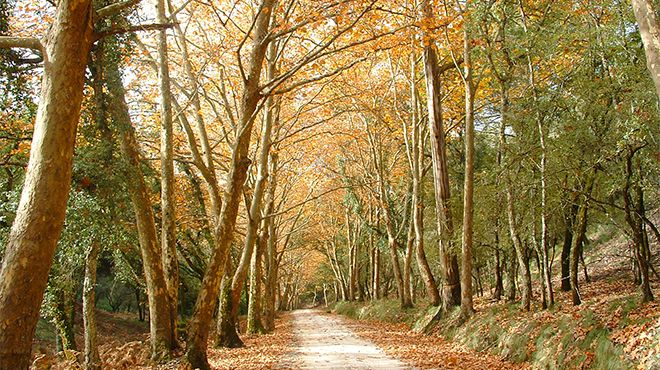
Spring (April-June) offers lush vegetation and waterfalls at peak flow. Summer is high season for swimming. Autumn colours the oak forests. Winter is cold and rainy at altitude, but the park remains open.
Yes, several natural swimming areas are permitted, notably near the Fecha de Barjas waterfall and on the Caldo river. Some river beaches are developed and supervised in summer.
A car is almost essential to connect the different sectors (Gerês, Soajo, Lindoso, Peneda). Bus services from Braga or Arcos de Valdevez exist but are infrequent and don't serve all sites.
The Iberian wolf is present but very elusive. Chance sightings remain rare. The Iberian Wolf Recovery Centre, just outside the park, provides insights into the species.
Two days allow you to cover the Gerês sector and the espigueiros of Lindoso. To also explore the Peneda sector and its remote villages, allow at least four to five days.
Yes, Braga is the natural logistical base. A day in town is enough for the main monuments, before heading to the park by car in less than an hour.
Interested in this visit?
We can include it in your personalised itinerary.