Viseu
Viseu
Perched on a granite plateau in central Portugal, Viseu brings together a Manueline cathedral, the Museu Grão Vasco, and a remarkably preserved medieval old town, at the gateway to the Dão wine region.
Viseu is a city in the centre-north of Portugal, district capital and historical heart of the Dão-Lafões region. Perched on a granite plateau, it preserves a remarkably intact medieval old town, a Romanesque cathedral, a museum among the country's finest, and a renowned winemaking tradition. Less visited than Porto or Lisbon, it offers authentic, human-scaled Portuguese experience.
Practical Info at a Glance
- Access: Viseu has no railway station; reach it primarily by coach (Rede Expressos from Lisbon, Porto, Coimbra) or by car via the A25 and IP5.
- Recommended duration: a full day for the old town; two days to include the surrounding area and Dão wine region.
- Dress code: smart casual required to visit the cathedral and chapels.
- Accessibility: the historic centre is largely cobbled and sloped; some sections are challenging by wheelchair.
What You'll See
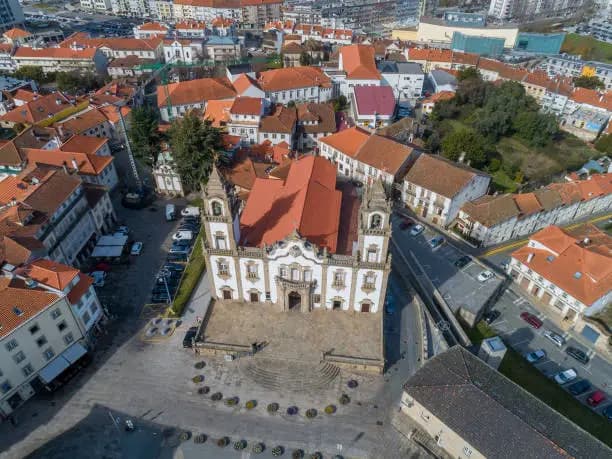
The heart of Viseu revolves around the Praça da Sé, a granite square framed by the cathedral and episcopal palace. The Rua Direita, a medieval shopping street, descends toward the lower town with its wrought-iron balconied houses. The Parque Aquilino Ribeiro provides a central green space beloved by locals.
History and Context
Viseu has been inhabited since the Iron Age. The Romans established a military camp; the city later became a Visigothic bishopric. In the Middle Ages, it developed around its cathedral. Local tradition attributes to Viseu the birthplace of painter Vasco Fernandes, known as Grão Vasco (c. 1475–1542), a major figure in Portuguese Renaissance. This artistic identity remains central to the city's image.
Highlights of Your Visit
Viseu Cathedral – Sé de Viseu
Founded in the 12th century, the cathedral features a sober Baroque façade and a Gothic-Manueline interior. The vault of the main nave, with intertwined rope-like ribs, stands as one of the most elegant examples of Manueline style in Portugal. The adjoining Renaissance cloister deserves particular attention.
Museu Grão Vasco
Housed in the former episcopal palace adjoining the cathedral, this museum preserves an exceptional collection of paintings by Vasco Fernandes and his workshop, including the celebrated São Pedro. The collection also spans sacred art, sculpture, and Portuguese decorative arts from the 15th to 20th centuries.
Rua Direita and the Historic Centre
This pedestrian street concentrates craft shops, cafés, and period mansions. It connects the cathedral square to the lower town's commercial hub. Adjacent alleyways reveal corbelled houses and granite fountains.
The Dão Wine Region
Viseu is the informal capital of the Dão wine region, renowned for its structured reds based on Touriga Nacional and crisp whites based on Encruzado. Several estates nearby offer tours and tastings.
Etiquette and Visiting Rules
- Clothing covering shoulders and knees to enter the cathedral.
- Quiet and discretion during religious services.
- Photography generally permitted in the cathedral outside services; check restrictions at the museum.
Photography Tips
The Praça da Sé is most striking in late afternoon, when raking light brings out the grey-gold granite. To photograph the cathedral façade without backlighting, favour the morning. From the Adro da Sé (raised forecourt), views across the lower town's roofscape are unobstructed.
Location and Access
Viseu sits in central Portugal, roughly 90 km north-east of Coimbra and some 130 km south-east of Porto. The old town is entirely walkable from the centre. Long-distance coaches arrive at the bus station, a few minutes' walk from the core. By car, paid parking is available just beyond the historic centre's perimeter.
Around Viseu
- Coimbra — medieval university city home to one of Europe's oldest universities, roughly 90 km south-west.
- Guarda — fortified highland town with an imposing Gothic cathedral, around 75 km to the east.
- Lamego — Baroque city renowned for its Nossa Senhora dos Remédios sanctuary and Douro wine region, around 50 km to the north.
- Dão Wine Region — esteemed wine appellation stretching around Viseu, ideal for wine routes.
Frequently asked questions
Spring (April–June) and autumn (September–October) offer pleasant temperatures and fewer tourists. Summer is hot and dry; winter can be cold on this inland plateau.
Viseu has no railway station. The most convenient option is coach (Rede Expressos) from Porto, Lisbon, or Coimbra, or a car via highways A25/IP5.
Yes, shoulders and knees must be covered. Avoid short shorts and sleeveless tops.
Yes. Viseu pairs well with Coimbra, Lamego, and Guarda on a multi-day circuit through central-north Portugal.
The museum charges admission; exact rates and hours should be verified directly with the museum or its official website before your visit.
Several Dão producers welcome visitors. It is advisable to contact estates in advance to arrange a tour and tasting.
Want to discover this destination?
Our local advisors design your tailor-made trip.