Évora
Évora
Évora concentrates two millennia of history within its walls: a Roman temple, the Sé cathedral, the Chapel of Bones and a 16th-century aqueduct, all UNESCO World Heritage sites.
Évora is the capital of Alentejo, designated a UNESCO World Heritage site since 1986. Its Roman walls, ancient temple and medieval alleyways form a rare, nearly intact urban ensemble. Just two hours from Lisbon, the city concentrates two millennia of history within a perimeter that can be explored entirely on foot.
Quick practical facts
- Access from Lisbon: Intercidades train from Oriente station (approximately 1h30) or Rede Expressos bus (approximately 1h45).
- Recommended duration: one full day for the main sites; two days to explore the surrounding area.
- Dress code: shoulders and knees covered for the cathedral and chapels.
- Accessibility for people with reduced mobility: the historic centre is paved and steep; some sites have adapted access, but mobility remains limited.
What to see
The Roman Temple (1st–2nd century CE), wrongly called the "Temple of Diana", stands with its Corinthian columns in the very heart of the city. The Sé cathedral, Romanesque and Gothic, has dominated the rooftops since the 12th century. The Chapel of Bones, within the church of São Francisco, lines its walls with human skulls and bones — approximately five thousand monks rest here. The Aqueduct of Prata, stretching several dozen kilometres, enters the city through a monumental arch.
History and context
Évora began as a Lusitanian settlement, then became a thriving Roman city known as Liberalitas Julia. In the Middle Ages, it became a Portuguese royal residence. The university, founded in 1559 by Cardinal Henry, was closed when the Jesuits were expelled in 1759 and did not reopen until 1979. This long interruption partly explains the exceptional preservation of the urban fabric.
Highlights of a visit
The Roman Temple
Fourteen Corinthian columns of local granite, standing approximately eight metres high, have remained upright since antiquity. In the Middle Ages, the temple served as a butchery, which paradoxically contributed to its preservation. It is freely accessible from the surrounding square.
The Chapel of Bones
Built in the 16th century by Franciscan monks, the chapel is entirely lined with human remains. The inscription at the entrance — "We bones that lie here, for yours we wait" — recalls the vanity of existence. Entry is paid; a visit takes approximately twenty minutes.
Évora's Sé Cathedral
Portugal's largest medieval cathedral. Its Gothic cloister, side chapels and sacred art museum deserve an hour of exploration. Ascending to the terraces offers an unobstructed view over the rooftops and the Roman temple.
The Aqueduct of Prata
Built in the 16th century on Roman foundations, it supplied the city with water from the Prata spring. At the northern entrance to the city, the arches span streets and houses have been built against its pillars — a unique architectural coexistence.
Etiquette and visiting rules
- Shoulders and knees covered in the cathedral and chapels.
- Silence and discretion in active places of worship.
- The Chapel of Bones is a place of reflection: respectful behaviour is expected.
Photography tips
The Roman temple is most photogenic in late afternoon, when slanting light gilds the granite. For the Chapel of Bones, interior lighting is dim: a camera with good low-light performance is useful. The cathedral terraces offer a unique framing of the temple and the city's white rooftops.
Location and access
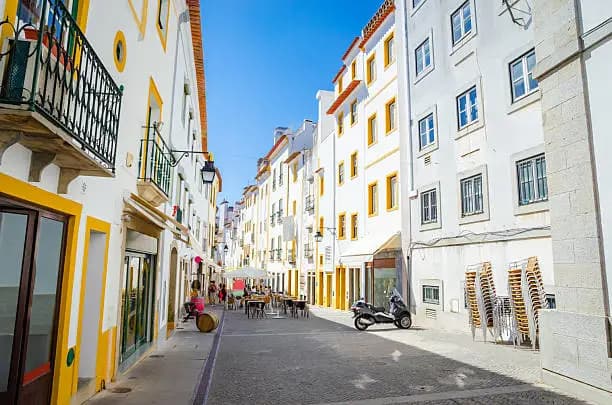
Évora sits at the heart of Alentejo, approximately 130 km east of Lisbon. The historic centre is entirely surrounded by medieval walls and can be explored on foot. The railway station is a few minutes' walk from the walls. Walking tours are offered by several local operators departing from Praça do Giraldo, the central square.
In the surrounding area
- Almendres Cromlech — one of Europe's largest megalithic complexes, about fifteen kilometres west of Évora.
- Zambujeiro Dolmen — the Iberian peninsula's largest dolmen, in the nearby Alentejo countryside.
- Monsaraz — fortified hilltop village approximately 50 km to the east, with views over Lake Alqueva.
- Estremoz — white marble town with its medieval castle and Saturday market, approximately 45 km to the north.
Frequently asked questions
Spring (March–May) and autumn (September–October) offer pleasant temperatures. The Alentejo summer is very hot, often exceeding 35°C; plan visits for early morning.
Yes, as a day excursion. The train from Oriente is fast and convenient. Allow at least six hours on-site to see the main attractions without rushing.
It can be unsettling for younger visitors. The atmosphere is dark and the subject matter is explicitly funereal. Only you can judge based on your child's sensitivity; many families visit without issue.
Yes, megalithic sites such as the Almendres Cromlech or Zambujeiro Dolmen are not served by public transport. A rental car or taxi from Évora is necessary.
Alentejo is the region of Iberian black pork (porco preto), migas, açorda and sheep's cheese. Alentejo wine, robust and fruity, naturally accompanies these dishes.
Photography is generally allowed inside, but rules may change. Check at the entrance and avoid flash out of respect for the space.
Want to discover this destination?
Our local advisors design your tailor-made trip.