Aveiro
Aveiro
Known as the Venice of Portugal, Aveiro blends colorful canals, Art Nouveau facades, traditional salt marshes and beaches of the Costa Nova, just an hour from Porto.
Aveiro is the capital of the district of the same name in northern Portugal. Its tourist appeal lies in the architectural richness of its houses and buildings, as well as its network of canals reminiscent of Venice.
History
The name "Aveiro" is first mentioned in 959 in the will of Countess Mumadona Dias. In this testament, the deceased countess entrusted the responsibility of the lands to the priests of the Guimarães monastery. At that time, Aveiro was not yet recognized as a city in its own right by Portuguese royalty.
Over the years, Aveiro's economy developed around fishing and maritime trade. The population residing around its salt marshes grew slowly but steadily. By the 13th century, the number of inhabitants was significant enough to raise Aveiro to the status of "vila" (town).
The city is traversed by the Ria de Aveiro river. The growing population impacted the canal connecting the river to the sea, prompting authorities to engage two engineers to solve the problem: Colonel Reinaldo Oudinot and Captain Luis Gomes de Carvalho. In 1808, the two men succeeded in building a dyke that stabilized the flow in the canal. Later, this waterway would become Aveiro's main attraction.
Aveiro quickly became a preferred destination for travelers visiting Portugal. The need to improve access to the city became apparent. Thanks to parliamentarian José Estêvão Coelho de Magalhães, the railway was extended to the city in the 19th century.
Why Visit Aveiro?
Aveiro is an emblematic city of Portugal. You can see historic Aveiro, as well as the city's current canals, featured on Portuguese postcards.
Aveiro's Architectural Wealth
Since the 18th century, European architecture has continued to evolve. You'll be surrounded by buildings paying homage to "Art Nouveau" on most city streets. Renowned European artists left their mark here: Ernesto Korrodi, José de Pinho, Silva Rocha, Carlos Mendes and Jaime Inácio dos Santos.
"The House of Major Pessoa" stands out with its floral and arabesque composition, crafted in stone and iron. The structure was created by Korrodi and Rocha. The latter also built "the residence building." You can admire this residence while strolling through Rua do Carmo. The villa is distinguished by its colorful high walls adorned with azulejos featuring floral themes (azulejos are handpainted ceramic tiles typical of Portugal).
About fifty meters from Aveiro's canals lies the Infante D. Pedro municipal park. At the heart of the park stands a sort of orthogonal kiosk. The structure is adorned with wrought iron in Art Nouveau style, earning it the name "Infante D. Pedro music kiosk."
Also worth seeing:
- The Rossio building at Largo do Rossio
- The As Americas hotel on Rua Engenheiro Von Haff
- The Agricultural Cooperation building on Rua João Mendonça
- The Ergovisão store on Rua De Coimbra
- The House of Ovos Moles on Rua João Mendonça
- The City Museum on Rua João Mendonça
- Pension Ferro restaurant on Rua Tenente Resende
Boat Tours in Aveiro
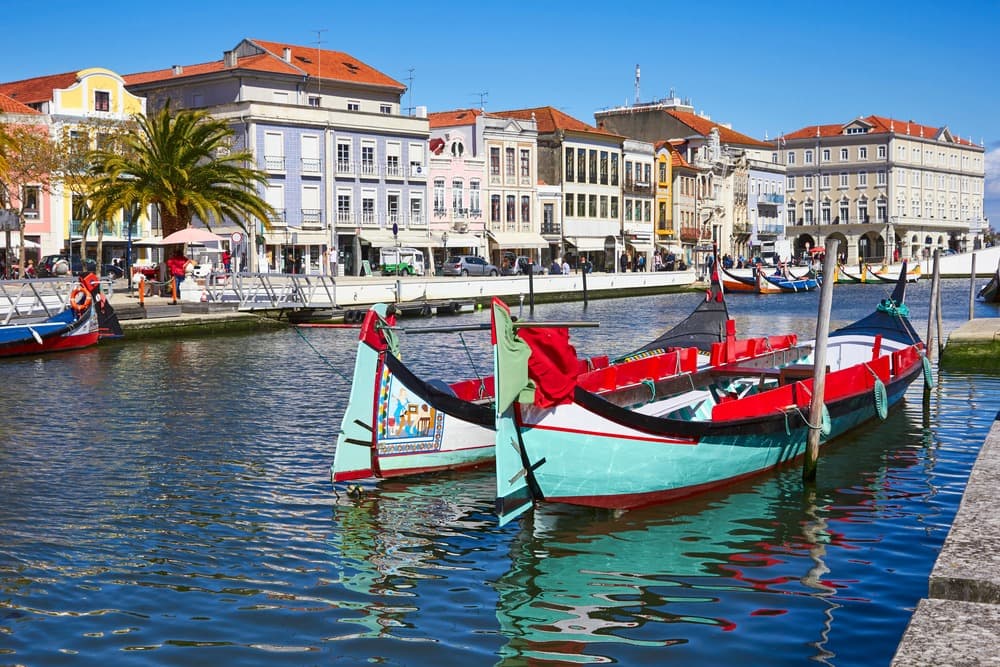
The city is renowned for its network of fluvial canals. Boat excursions are essential activities. The moliceiros are typical of Aveiro. These small cruise boats are brightly colored. The banks are lined with streetlamps, flower pots and small shrubs. The pedestrian walkways are decorated with azulejo frescoes. A tour of Aveiro by moliceiro will give you another perspective of the city.
Best Time to Visit?
From March to November, Aveiro enjoys constant sunshine and temperatures don't exceed 26°C. It rarely rains. This period is ideal for visiting the city.
Aveiro's residents celebrate the feast day of São Gonçalo de Amarante (January 10) each year. He is the city's patron saint. For this celebration, people gather in the Beira Mar neighborhood. "Cavacas" (small Portuguese biscuits) are tossed from the chapel of São Goncalinho. According to local belief, throwing one of these small pastries from the church will grant your wishes. If you're interested in attending this festival, travel to Aveiro in early January.
Aveiro is connected to other major Portuguese cities by rail. Long-distance buses are also available.
Aveiro's city center is exclusively pedestrian. Cars must park in parking lots just at the city center's entrance.
Moliceiros are of course available for a guided tour of Aveiro along the city's canals.
Want to discover this destination?
Our local advisors design your tailor-made trip.